

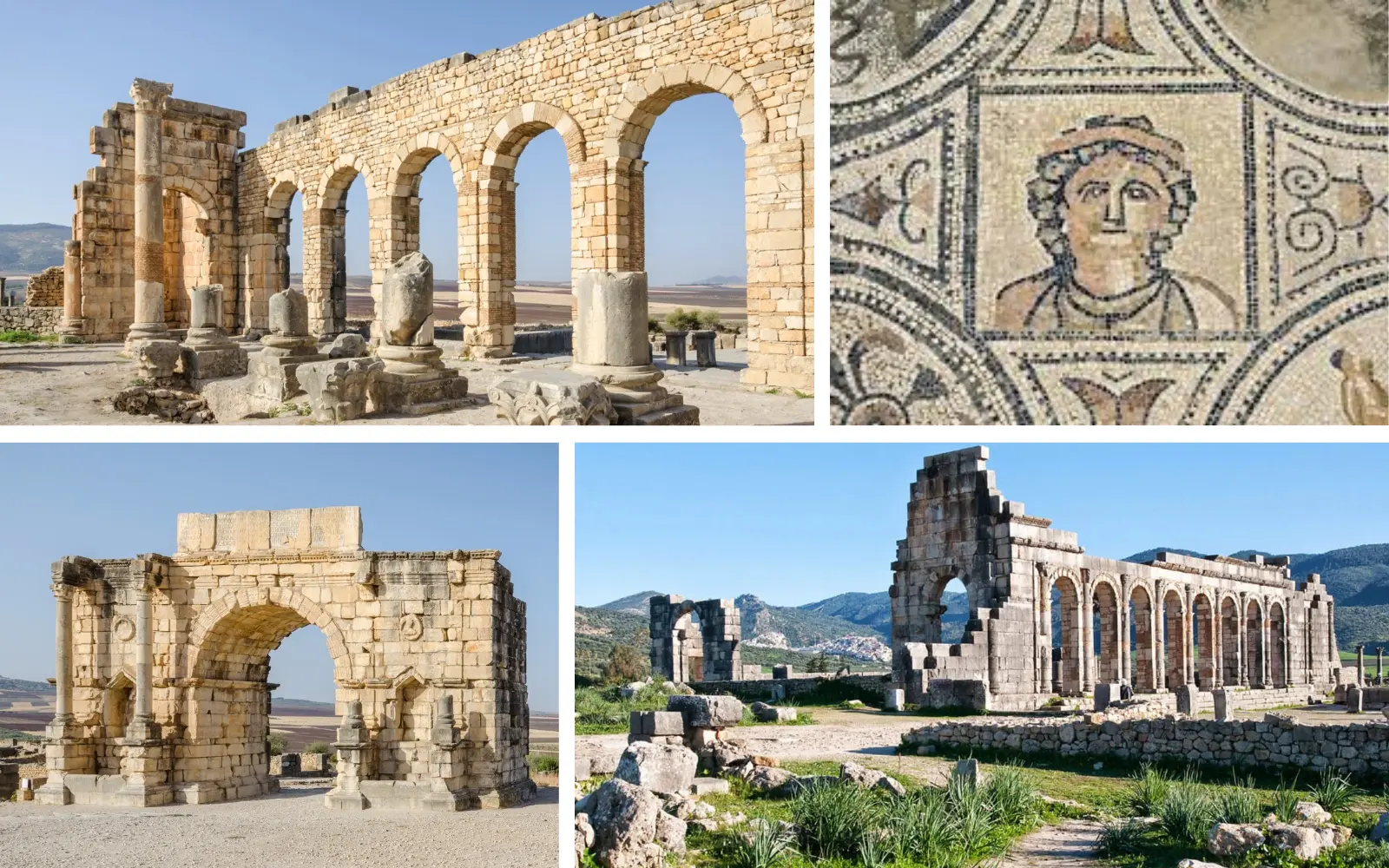
If your Morocco itinerary is starting to blur into a beautiful sequence of medinas, riads, gates, and souks, Volubilis Morocco is the reset button. The site does not feel like a harsh imperial frontier at all. It sits in a fertile landscape of rolling fields and olive country near Jebel Zerhoun, and that setting changes everything: the old stones feel less abandoned than suspended in a green, prosperous memory. That is exactly why Volubilis Morocco stands out from the usual circuit. It offers a rare UNESCO detour into Roman North Africa without asking you to decode another maze-like old city.
Quick facts for travelers and featured snippets
Status: UNESCO World Heritage Site since 1997.
Peak population: about 20,000 residents at its height.
Main draw: remarkably rich in-situ Roman mosaics, plus major civic remains like the basilica, forum, and Arch of Caracalla.
1. Why Volubilis Morocco mattered
The story of Volubilis Morocco starts long before the Romans. The wider area shows occupation going back to the Neolithic, while the town itself had a Mauretanian and Punic phase before Rome fully absorbed it. That is why the site matters so much historically: this is not just a Roman postcard, but a layered settlement where Berber, Carthaginian, Roman, and early Islamic histories overlap. In local memory and Arabic usage, the site is also tied to Walili Morocco, a name linked to the oleander plant.
One of the most fascinating chapters centers on Juba II and Cleopatra Selene, daughter of Mark Antony and Cleopatra VII. Raised in Rome but ruling in North Africa, Juba II helped shape Volubilis into a polished, Romanized city while remaining rooted in a Mauretanian kingdom. That mixture of local identity and Roman ambition is visible all across the site, from its urban planning to its decorative art.
The real engine behind the city was agriculture and trade. Volubilis flourished because the surrounding plain was productive: wheat, olive oil, and other agricultural goods moved outward through Roman networks, while wild animals from the region were also sent for gladiatorial spectacles. The site’s many oil-pressing complexes still make that old economy easy to imagine. When you walk through the Volubilis archaeological site, you are not just seeing ruins; you are seeing the remains of a city that was fed by land, labor, and empire.
2. A cinematic and visual masterclass
Visually, Volubilis Morocco is one of those places that almost edits itself. The broken arches, columns, and open sky create a ready-made cinematic frame, and the white storks nesting on Roman capitals are among the site’s most memorable images. They appear so often in photography of Volubilis because they turn the ruins into something living: not a dead museum, but a landscape where nature has moved into history.
There is also a useful correction to make here. Some travelers loosely connect the Roman atmosphere of Volubilis with Gladiator, but the commonly documented filming location for the film’s North African town of Zucchabar is Aït Ben Haddou, not Volubilis. That does not make Volubilis ruins Morocco any less cinematic. If anything, it makes the site more interesting: you do not need a film credit when the basilica, triumphal arch, and open valley already give you an “Ozymandias” feeling about the rise and fading of empires.
3. The mosaics: what not to miss
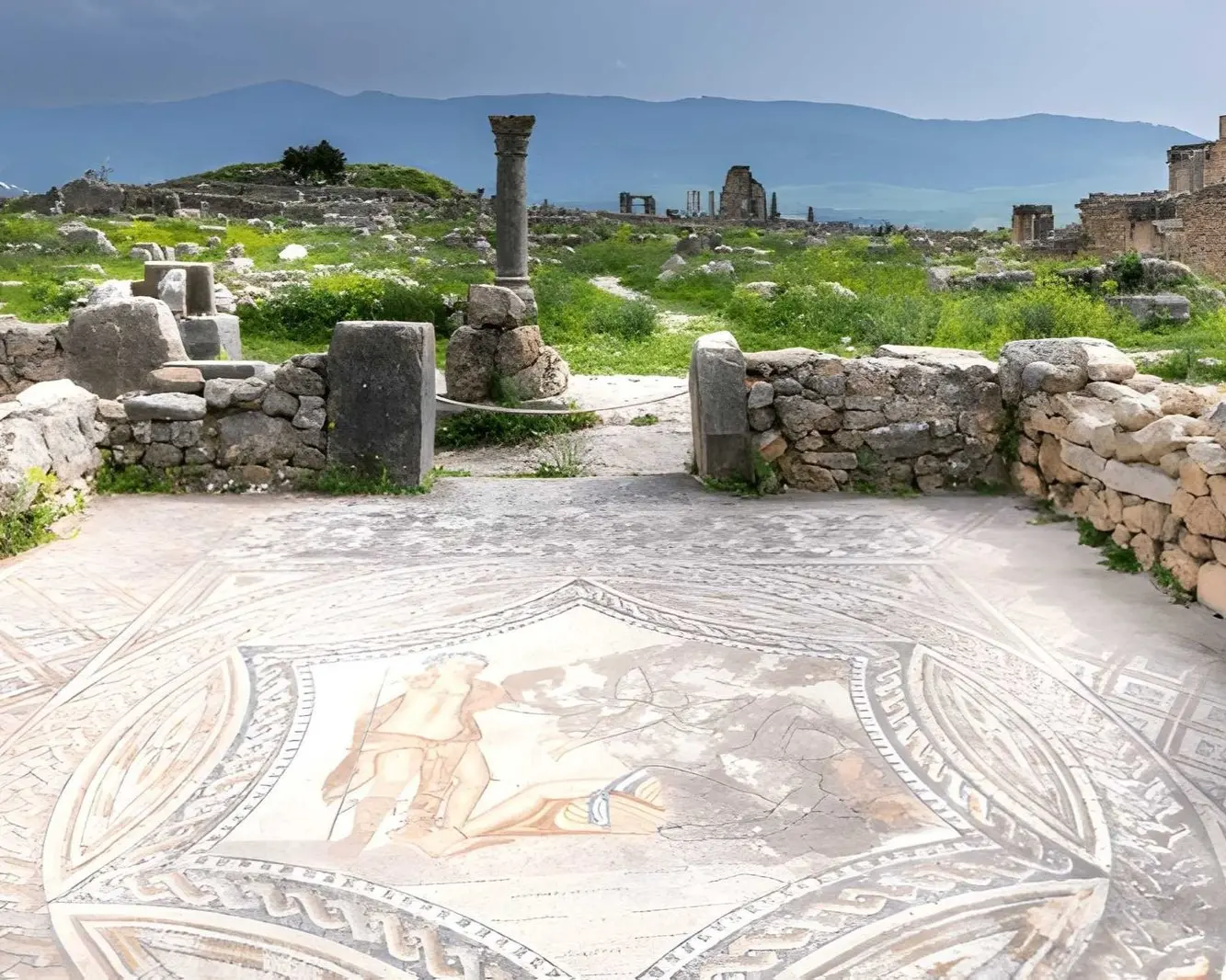
The real genius of Volubilis Morocco is on the ground. Its mosaics are not tucked away in a museum by default; many still lie where elite households once displayed them. That gives the site a rare intimacy. You are not just looking at Roman art. You are standing inside Roman domestic space.
| Mosaic / House | Why it matters |
|---|---|
| House of Orpheus | Famous for Orpheus charming animals with music; also associated with visible olive-press infrastructure nearby, a reminder that luxury here was built on olive wealth. |
| House of the Labours of Hercules | A classic must-see, with the twelve labours laid out in a striking narrative mosaic. |
| House of Venus | One of the most sumptuous houses in the city, with mythological scenes including Diana surprised while bathing and the story of Actaeon. |
| The Acrobat / Desultor | A witty, memorable mosaic showing a rider mounted backward on a donkey, often read as comic or performative rather than heroic. |
These identifications and descriptions are supported by the site map, image archives, and specialist travel/heritage references.
If you only have an hour, prioritize the House of Orpheus, the House of Venus, and the House of the Labours of Hercules. Together, they explain why Volubilis Morocco is so much more than a collection of columns. They show mythology, status, taste, and daily life all at once.
4. The imperial trio: Volubilis, Meknes, and Moulay Idriss
The smartest way to experience Volubilis Morocco is not in isolation but as part of a three-part day trip with Meknes and Moulay Idriss Zerhoun. Together, the three places tell a story of succession: Roman power, Idrisid legitimacy, and Alaouite imperial reuse.
First comes Meknes, the material successor. Historical sources note that Volubilis was quarried for later construction, and marble columns from the Roman city were reused in Meknes, including at Bab Mansour. In other words, the stones of Volubilis did not simply fall; some were carried forward into Morocco’s later imperial architecture.
Then comes Moulay Idriss Zerhoun, the spiritual anchor. The town sits only about 3 to 4 kilometers from Volubilis and is tied to Idris I, founder of the Idrisid dynasty. UNESCO describes Volubilis as briefly becoming the capital of Idris I, while later scholarship and site research identify Walila as his early base or headquarters. The nearby town is also known for the striking cylindrical minaret of the Sentissi Mosque, one of the most unusual minarets in Morocco.
5. Planning your Volubilis Morocco visit
Here is the practical table most readers actually need:
| Category | Detail | Cost / Time |
|---|---|---|
| Entry Fee | Foreign adult ticket | 100 MAD |
| Hours | Open daily | Sunrise to sunset |
| Guide Fee | Official guide at the entrance | Around 300 MAD |
| Best Season | Spring is ideal | Mild weather, green landscapes, wildflowers |
| Private Transfer from Meknes | Comfortable round-trip transfer with driver | Ideal for couples, families, and small groups |
| Private Day Trip | Combine Volubilis, Moulay Idriss, and Meknes in one itinerary | Best option for a smooth cultural day trip |
| Travel Time from Meknes | Direct drive to Volubilis | Around 40 to 50 minutes |
| Travel Time from Fes | Private excursion with hotel pickup | Around 1.5 to 2 hours |
| Best Transport Choice | Private car or minivan | More flexible, comfortable, and time-saving. Contact us |
Official site information confirms the entry fee, opening hours, and on-site guide price. Budget transport figures are reported across recent travel references and can vary by season, crowding, and whether you take a shared seat or charter the ride.
One practical tip: if your priority is mosaic photography, do not rush in the second the gates open. Early and late light are beautiful for arches and columns, but for flat floor mosaics, waiting until the sun is a bit higher often reduces heavy shadow across the panels. For comfort, spring remains the best all-round season because the countryside is greener and the exposed site is much easier to enjoy than in peak summer heat.
6. The honest verdict: what to skip, what to bring, what to respect
If you are budgeting your day, prioritize Volubilis Morocco itself over thinner add-ons. Meknes is worth seeing, but if time is short, do not spend too much money chasing every secondary ruin. Put the focus on the Roman site and then pair it with Moulay Idriss for contrast. That combination gives you architecture, religion, landscape, and state formation in one sweep.
There is also an ethical side to visiting. The mosaics are magnificent, but they are vulnerable. Conservation work has continued in recent years, including projects focused on the House of Orpheus and other mosaic panels, which tells you two things at once: the art is precious, and it still needs protection. Responsible travelers should stay off fragile surfaces, respect barriers, and avoid treating the site like a photo prop.
Bring water, sunscreen, and a hat or parasol. There is very little shade on the site, the walking surface is uneven, and you will enjoy Volubilis ruins Morocco far more if you dress for exposure rather than for city sightseeing. A refillable bottle, comfortable shoes, and a bit of cash will solve most practical problems.
7. The wisdom of stones
In the end, Volubilis Morocco is not just a side trip from Fes or Meknes. It is one of the rare places where Morocco’s deep historical layers become physically legible under your feet. You walk past olive presses, basilicas, mythological mosaics, Idrisid memory, and stork nests built on Roman columns. Few sites make the past feel this grand and this human at the same time.
That is why Volubilis Morocco lingers. You do not leave with the feeling that you merely “visited ruins.” You leave with the sense that you briefly stepped into a place where Berber land, Roman power, and Moroccan memory still speak to each other. And that is exactly the kind of heritage that enriches the world.
9. FAQ
What is Volubilis in Morocco?
Volubilis is an ancient Roman archaeological site in northern Morocco, near Meknes and Moulay Idriss. It is one of the country’s most important historical landmarks and has been a UNESCO World Heritage Site since 1997.
Why is Volubilis Morocco famous?
Volubilis Morocco is best known for its well-preserved Roman ruins, monumental remains, olive presses, and beautiful mosaics that still survive on site. UNESCO recognizes it for showing Roman urban development and the meeting of Roman and indigenous cultures.
Is Volubilis worth visiting?
Yes. Volubilis is worth visiting if you enjoy history, photography, archaeology, or day trips from Meknes and Fes. It offers a very different experience from Morocco’s medinas and is one of the country’s most rewarding open-air heritage sites.
Where is Volubilis located?
Volubilis is located at the foot of Jebel Zerhoun in northern Morocco, close to Meknes and the holy town of Moulay Idriss Zerhoun.
How much is the entry fee for Volubilis?
The official Volubilis site currently lists the entrance fee for adult foreign visitors at 100 MAD. Since pricing can change, it is a good idea to recheck before your visit.
What are the opening hours of Volubilis?
The official site currently states that Volubilis is open every day from sunrise to sunset.
Are guides available at Volubilis?
Yes. The official site says official guides are available at the entrance, with a listed guide price of 300 MAD.